The Great Solar Wall: China’s New Export Controls and India’s Path to Energy Sovereignty
The global energy transition just hit a hard reality. On 16 October 2026, China’s Ministry of Commerce (MOFCOM) and the Ministry of Science and Technology (MOST) dropped Joint Announcement No. 48. It's a decree that signals a shift from simple trade rivalry to full-blown supply-chain warfare.
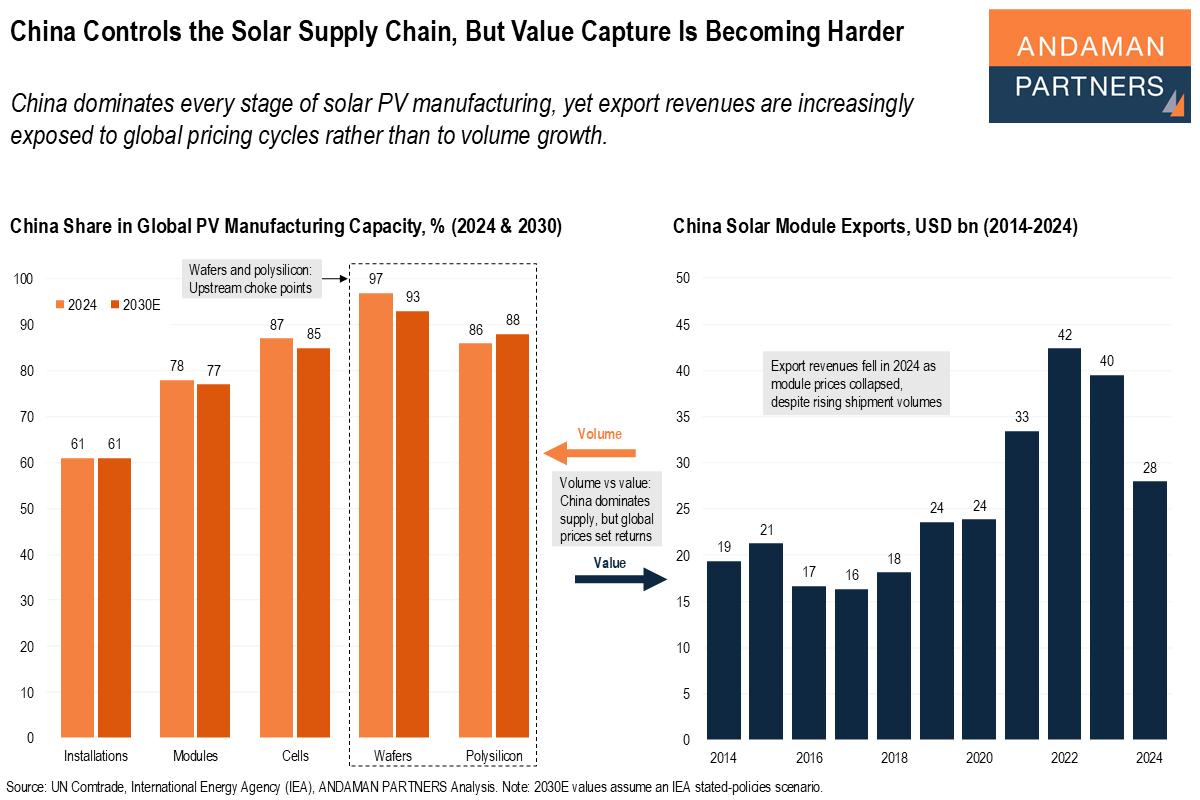
By slapping strict export controls on 12 essential solar manufacturing technologies, Beijing isn't just competing on the price of a panel anymore. They're guarding the "intellectual substrate" of the world's future power. For India, currently racing toward a 500 GW non-fossil capacity target by 2030, this is a massive wake-up call. The message is blunt: the era of "imported decarbonisation" has ended. We either innovate at home or we get left behind.Research Image
The New Architecture of Control
China’s updated Catalogue of Technologies Prohibited or Restricted from Export doesn't target the finished product; it goes for the throat of the industry. You can still buy the modules, but the machinery and the specialized "know-how" to build them are now locked behind a licensing wall.
Key Technologies Under the Thumb:
- Prohibited (Total Ban): Manufacturing processes for perovskite-silicon tandem cells (the ones hitting 30% efficiency) and large-area single-junction perovskite modules.
- Restricted (Licensing Required): High-end crystalline-silicon tech, including TOPCon, HJT (Heterojunction), and back-contact technologies.
- Upstream Bottlenecks: Thin-silicon wafering, fluidized-bed polysilicon production, and high-precision slot-die coating.
Strategic Insight: This isn't a blanket ban. It’s a moat. It ensures the world can consume solar energy, but China remains the only one with the tools to build the factory.

The Indian Dilemma: A 95% Dependency
India’s solar dreams are currently built on a shaky foundation. We’ve managed to hit a module assembly capacity of 233 GW (as of June 2026), but the reality further up the chain is sobering. Our solar cell capacity is a measly 38 GW. That's a massive "midstream gap" that leaves the country wide open to price spikes.
The Reality of the Supply Chain (FY2026 Data)
| Component / Metric | Status | Key Statistic |
|---|---|---|
| Solar Cell Imports | Dominance | China supplies ~95% of India’s cells |
| Import Expenditure | Rising | ₹27,133.68 crore (up 95% YoY) |
| Silicon Wafers | Near-Monopoly | China accounts for >99% of imports |
| Production Machinery | Captive | ~90% of factory tools are Chinese-sourced |
It’s not just about the product. It’s about the hardware. To start a "Make in India" factory today, an entrepreneur almost always has to buy Chinese wire-saws, PECVD reactors, and automated stringers. The government’s Production-Linked Incentive (PLI) Scheme has helped assemble modules, sure. But it hasn't yet fixed the "machinery gap." We're still importing the tools to build the tools.Research Image
The 2026–2028 Gap: Navigating the Interim
The fallout from Joint Announcement No. 48 is already hitting Indian boardrooms. Projects that are live right now face sudden price jumps as securing licensed Chinese machinery becomes a nightmare. This will likely delay Power Purchase Agreements (PPAs) while developers try to make the maths work.
How do we bridge the gap until our own tooling matures in 2028? Manufacturers are scrambling for alternatives. High-precision gear from Germany (Meyer Burger), Switzerland (Schmid), and South Korea offers a way out, but there's a catch: it usually costs 15–20% more. At the same time, India is leaning on the QUAD Clean Energy Supply Chain initiative to share tech and stop relying on a single point of failure.
Beyond Panels: The Battle for Storage
This isn't just a solar problem. Beijing’s strategy of controlling the process, not just the material, has moved into grid-scale batteries. The solar crisis is being mirrored in the energy storage world, where China dictates the rules for Lithium Iron Phosphate (LFP) chemistry.
- The Price Gap: Chinese LFP cells are 30% cheaper than anything domestic or Western as of late 2026.
- The Refining Grip: China controls 75% of purified phosphoric acid and 95% of battery-grade manganese sulphate.
- The Scale Problem: India has only commissioned 1.4 GWh of cell capacity under the Battery PLI scheme so far. China produced 237.8 GWh in September 2026 alone.
The Path to Sovereignty: Scaling Upstream R&D
If India wants real energy independence, we have to stop "assembling" and start "inventing." Importing Chinese machines to put together Chinese cells and calling it an "Indian" module? That won't work anymore.
A Roadmap for Autonomy:
- The Equipment Consortium: We need a Solar Equipment Innovation Consortium pairing the IITs with private industry. The goal? Homegrown India-made tabber-stringers and inspection systems by 2028.
- Hard R&D Cash: The Anusandhan National Research Foundation (ANRF) must fund the "boring" stuff—quartz processing for polysilicon and indigenous PECVD reactors.
- Strict Integration: The ALMM (Approved List of Models and Manufacturers) needs to change. It shouldn't just mandate domestic modules; it needs to require domestic wafers and polysilicon by 2028.
Editor’s Take: Innovation isn't a luxury; it’s national security. If we don't own the Intellectual Property (IP) for the manufacturing process, our energy transition is just a branch office of Chinese industrial policy.Research Image
Conclusion: The 2027 Horizon
The final rules for China’s controls will be set after the 15 November 2026 consultation. Whether India can push its cell manufacturing to 100 GW by mid-2027 depends on one thing: can we bypass these new barriers? It’ll take a mix of expensive imports and aggressive R&D. The days of easy tech transfers are over. The era of the Indian inventor has to start now.
Summary: The Deep-Dive in Brief
- China’s October 2026 export controls on solar tech target the "how-to" of manufacturing, creating a massive roadblock for global rivals.
- India is still exposed, importing 95% of its cells; surviving the 2028 equipment gap means using QUAD alliances and sourcing pricey gear from Europe and Korea.
- Real energy sovereignty requires moving past simple assembly to owning the IP and machinery, ensuring India’s green future isn't controlled by foreign policy.
Never Miss an Update!
Subscribe to get personalized blog recommendations and instant notifications for new articles directly on your device.