The Cost of Sovereignty: Is “Make in India” Artificially Inflating Clean Energy Tariffs?
For years, the narrative surrounding India’s green energy transition has been relentlessly celebratory. We have been fed a steady diet of triumph: that domestic manufacturing under the “Make in India” banner is the silver bullet to secure both national energy sovereignty and dirt-cheap power.
But as we look across the landscape in August 2026, a far thornier reality has run aground.
There is an uneasy, quiet consensus building among developers, economists, and energy wonks: Make in India is not bringing tariffs down; it is actively driving up the cost of hardware.
Even with aggressive basic customs duties and non-tariff barricades thrown up against imports, Chinese solar and storage tech remains radically cheaper than homegrown alternatives. If India simply opened the floodgates to Chinese hardware, solar tariffs would likely plunge to historic lows. But that path is a geopolitical trap, trading long-term energy security for a quick discount.
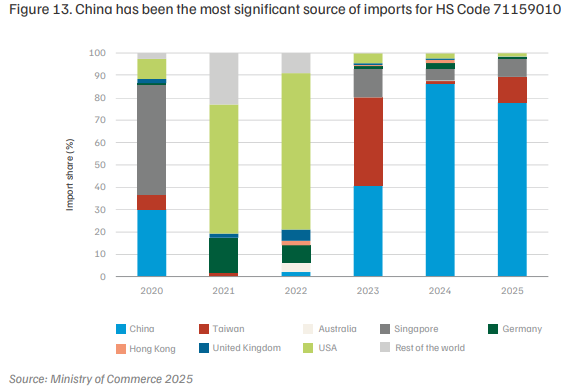
To make sense of this high-stakes tension, we must look closely at the steep price premiums of Domestic Content Requirement (DCR) solar panels, the actual inflation of recent tariff bids, the structural umbilical cord that still ties India’s green dreams to Beijing, and the bottleneck this protectionism is creating for the nation’s green hydrogen ambitions.
The Real Price Gap: The 40% DCR Premium and Tariff Inflation
The smoking gun of this “protectionist tax” is sitting right in the residential solar sector, specifically within the PM Surya Ghar Muft Bijli Yojana. To claim the government subsidy of ₹30,000 to ₹78,000, homeowners are legally bound to use DCR modules—meaning every single cell and finished panel must be minted within Indian borders.
Data from the first half of 2026 exposes a staggering pricing mismatch. While global module prices have fallen off a cliff, Indian DCR panels carry a massive markup of up to 40% over imported, non-DCR equivalents.
Solar Module Price Comparison (Q1/Q2 2026)
| Metric / Feature | DCR Modules (Domestic Cells & Modules) | Non-DCR Modules (Imported Cells / Chinese Origin) |
|---|---|---|
| Average Cost per Watt | ₹23 to ₹26 / W (Premium up to ₹30-36 / W for top-tier brands) | ₹15 to ₹18 / W (Imports/Non-DCR range ₹25-32 / W for high-end) |
| Upfront Price Gap | ₹8 to ₹11 per watt more expensive | Baseline global pricing |
| Subsidy Eligibility | Yes (Eligible for PM Surya Ghar / PM-KUSUM) | No (0% subsidy eligibility) |
| 1 MW Project Impact | Adds ₹80 lakh to ₹1.1 crore in capital expenditure | Standard competitive CAPEX |
| Primary Technology | Transitioning to N-Type TOPCon & Mono PERC | Ultra-high efficiency TOPCon (up to 745 Wp) |
A household consumer can swallow this premium because the state subsidy cushions the upfront blow. Utility-scale developers and commercial players have no such luxury. For them, this protectionist premium translates directly into higher bid tariffs.
Look at the utility-scale auctions run by the Solar Energy Corporation of India (SECI). The numbers tell the story. Tariffs that hovered around ₹2.50/unit in 2024 have stubbornly climbed, stabilising closer to ₹3.10/unit in recent 2026 auctions. This upward creep is the direct consequence of developers pricing in the hefty capital expenditure of domestic sourcing and hedging against regulatory bottlenecks.
The Dependency Paradox: Why “Made in India” Still Means “Sourced from China”
This premium exists because India’s solar manufacturing story is built on surprisingly thin ice. Yes, India has successfully scaled its module assembly capacity to 172 GW as of FY26. But its domestic cell manufacturing capacity remains a measly 27 GW.
To patch this gap, the government rolled out the Production Linked Incentive (PLI) Scheme (Tranches I and II). While several PLI-backed gigafactories have spun up operations as of Q2 2026, these plants remain heavily focused on simple assembly. They have not yet achieved the deep vertical integration or the immense economies of scale enjoyed by manufacturing hubs in Jiangsu or Anhui. In short, India has built the roof and walls of the house (modules) but still imports the bricks (wafers and ingots) from China.
The irony of this self-reliance drive is hard to miss:
- Cell and Equipment Reliance: China still dictates roughly 95% of India’s solar cell supply. Worse, to build out those domestic factories, Indian manufacturers must buy nearly 90% of their production machinery directly from Chinese vendors.
- SME Shutdowns: The hard mandate to use local cells has triggered severe supply-chain gridlocks. Among India’s 140 small and medium-sized solar manufacturers, one-third have reportedly shuttered production in 2026 while waiting for local cell allocations, facing crippling delays of 6 to 8 months.
- Policy Exemptions: Caught in this supply squeeze, the Ministry of New and Renewable Energy (MNRE) had to blink. In July 2026, it extended the ALMM-II (Approved List of Models and Manufacturers) exemption for net-metering and open-access green energy projects until December 31, 2026.
The Green Hydrogen Bottleneck: A High-Stakes Collision
This tariff creep does not just plague local power distribution companies (DISCOMs); it threatens to choke India’s ultimate decarbonisation trophy: the National Green Hydrogen Mission.
Green hydrogen is notoriously power-hungry. Electricity alone accounts for 60% to 70% of the levelised cost of hydrogen (LCOH). To make Indian green hydrogen competitive globally—and to hit the government’s target of producing 5 million metric tonnes by 2030—developers need rock-bottom input power, ideally under ₹2.00/unit.
By forcing developers to buy expensive domestic solar components, the “Make in India” mandate is keeping solar tariffs pinned above the ₹3.00/unit mark. This premium acts as an outright tax on hydrogen viability, threatening to price India out of lucrative export markets in Europe and Japan before the first shipments even leave port.
The Storage Pivot: Battery Storage and the BESS Premium
As the grid hits a critical tipping point in mid-2026, the focus of India’s energy transition has pivoted sharply from basic daytime generation to firm, dispatchable, round-the-clock power. Having reached 225.61 GW of total renewable capacity by May 2026, the grid simply cannot absorb more intermittent solar without massive storage systems. The Central Electricity Authority estimates India will need a whopping 236.2 GWh of Battery Energy Storage Systems (BESS) capacity by 2031-32.
This pivot is dragging the exact same tariff-inflating dynamics we saw in solar straight into the BESS sector, where the price gap is even more brutal.
- The Chinese Cost Advantage: Chinese lithium-ion cells, especially Lithium Iron Phosphate (LFP) chemistry, hold a steep 30% price advantage over Western and domestic options. China’s hyper-integrated supply chain and tight grip on critical minerals make it almost impossible for local players to compete on cost.
- Policy Interventions: In the Union Budget 2026–27, the government tried to soften the blow by extending basic customs duty exemptions on capital goods used for lithium-ion battery manufacturing until March 2028.
- The Domestic Content Trap: The tariff-hiking dynamics of solar are already playing out in the BESS auctions of early 2026. If India slaps strict domestic content mandates on storage batteries to force localisation—mirroring the US Inflation Reduction Act’s 50% threshold—the cost of grid-scale storage will surge, converting directly into higher peak-power tariffs.
Energy Security vs. Cheap Tariffs: The Ultimate Trade-off
This brings us to the heart of the matter. Is the claim that “Make in India is making tariffs low” flat-out wrong?
From a cold, hard economic perspective, yes. Protectionist rules, DCR mandates, and ALMM lists function as a tax on transition speed. They keep hardware costs artificially high, blocking tariffs from sliding down to the rock-bottom levels a free market flooded with cheap Chinese solar panels would deliver.
But obsessing solely over tariff optimisation misses the geopolitical forest for the trees. Decoupling from a near-monopoly global supplier is an incredibly expensive project. Global economic analyses in 2026 suggest that Western and allied economies would need to spend $23.6 trillion over the next quarter-century to replicate the manufacturing ecosystem currently concentrated in China.
For India, swallowing a 40% markup on solar panels and accepting slightly higher tariffs is not an economic failure; it is an insurance premium. Relying entirely on imported Chinese gear to keep India’s national grid online exposes the country to massive supply-chain shocks, geopolitical blackmail, and sudden trade bans.
“Make in India” is not a failure of economics, but a deliberate choice of values. Yet, as 2026 has shown, this choice arrives with a very clear bill: slower decarbonisation, squeezed green hydrogen targets, and higher monthly utility bills for the Indian consumer. The real question for the rest of the decade is no longer if we will pay this premium, but how much higher it can climb before the entire transition stalls out.
Summary: The Cost of Clean Energy Independence
- The Price Premium: Protectionist mandates have locked in a 40% markup on domestic solar panels, pushing recent 2026 tariff bids up to ₹3.10/unit.
- The Supply Bottleneck: Despite scaling assembly plants, Indian manufacturers remain structurally dependent on Chinese wafers, machinery, and battery cells.
- The Strategic Trade-off: Slower decarbonisation and higher tariffs are the unavoidable insurance premiums India must pay for its energy sovereignty.
Never Miss an Update!
Subscribe to get personalized blog recommendations and instant notifications for new articles directly on your device.