The Silent Giant of the Energy Transition: Finland’s 100,000-Year Solution to Nuclear Waste
The global conversation about energy has changed. It had to. The raw urgency of the climate crisis has finally burned away the old, stubborn resistance to nuclear power. We’re seeing nations everywhere scramble to plug the gaps in their grids with carbon-neutral baseload. But while everyone’s talking about the "front end"—the shiny new reactors and the rise of Small Modular Reactors (SMRs)—the "back end" has been a quiet, awkward problem.
Most of the world’s spent nuclear fuel is just sitting in limbo. It’s in wet pools or concrete casks on the surface of power plants, waiting for a permanent home that never seems to arrive. Still, the ground shifted this week. On October 22, 2026, the Finnish Government issued a historic operating license to Posiva, giving the green light to the world’s first permanent deep geological repository (DGR) at Olkiluoto.
This isn't just a win for Helsinki. It’s the first time we’ve stopped "managing" a problem and actually solved it for the next few thousand years.Research Image
Beyond the Surface: The Reality of Spent Fuel
We've been safe enough with high-level waste (HLW) so far. Interim storage works, but it isn't a long-term strategy. The World Nuclear Outlook Report 2026 makes a blunt point: if you want to build more reactors, you need to prove you can clean up the mess. You can't just leave it for the next generation.
The Problem with Temporary Storage
- Wet Storage Pools: These are great for cooling down hot fuel right after it leaves the reactor. But they’re high-maintenance. They need constant power and active cooling. That’s a liability we don't want to carry forever.
- Dry Casks: These are tougher and can sit on the surface for decades. But they’re still exposed. They depend on a stable government and a secure site. History tells us that’s a big ask over several centuries.
- The Scale of the Challenge: Look at the numbers. Shifting all the old fuel in the U.S. alone into dry storage would take over 2,700 new casks. 2026 has shown us that as we build more, the pile only gets bigger.
The Social License: Why Finland Succeeded
Finland didn't get here by accident. It wasn't just about having the right rocks. It was about how they treated the people living on top of them. While the U.S. and the U.K. have spent decades fighting "Not In My Backyard" (NIMBY) protests, Finland took a different path.
They gave the host town, Eurajoki, a veto. Right from the start. They didn't force a mandate from the top down. Instead, Posiva and the government spent forty years talking to the locals. They made sure the community saw the economic benefits and understood the science. The International Atomic Energy Agency (IAEA) now calls this the gold standard. It’s simple: you don't build something this big without getting a "yes" first.
ONKALO: A Masterpiece of Engineered Safety
They call it ONKALO. In Finnish, that just means "the pit." It’s a massive facility carved 400 to 450 metres deep into 1.8-billion-year-old granite. The safety of the site relies on the "KBS-3" system. Think of it as a series of redundant barriers. If one fails, the next one takes the hit.
The Five Layers of Protection
- The Fuel: It’s not a liquid. It’s solid ceramic pellets (uranium dioxide). They don't just dissolve in water.
- Copper Canisters: These are the heavy hitters. Each canister has a cast iron inner core for strength and a 50mm thick copper skin to stop corrosion.
- Bentonite Clay: The canisters go into holes lined with this volcanic clay. When it gets damp, it swells up and creates a waterproof seal. It also keeps bugs out.
- Tunnel Backfill: Once a tunnel is full, they pack it with more clay and seal it with massive concrete plugs.
- The Bedrock: The Finnish shield is the final wall. It’s solid, stable rock that keeps the waste away from the air we breathe and the water we drink.
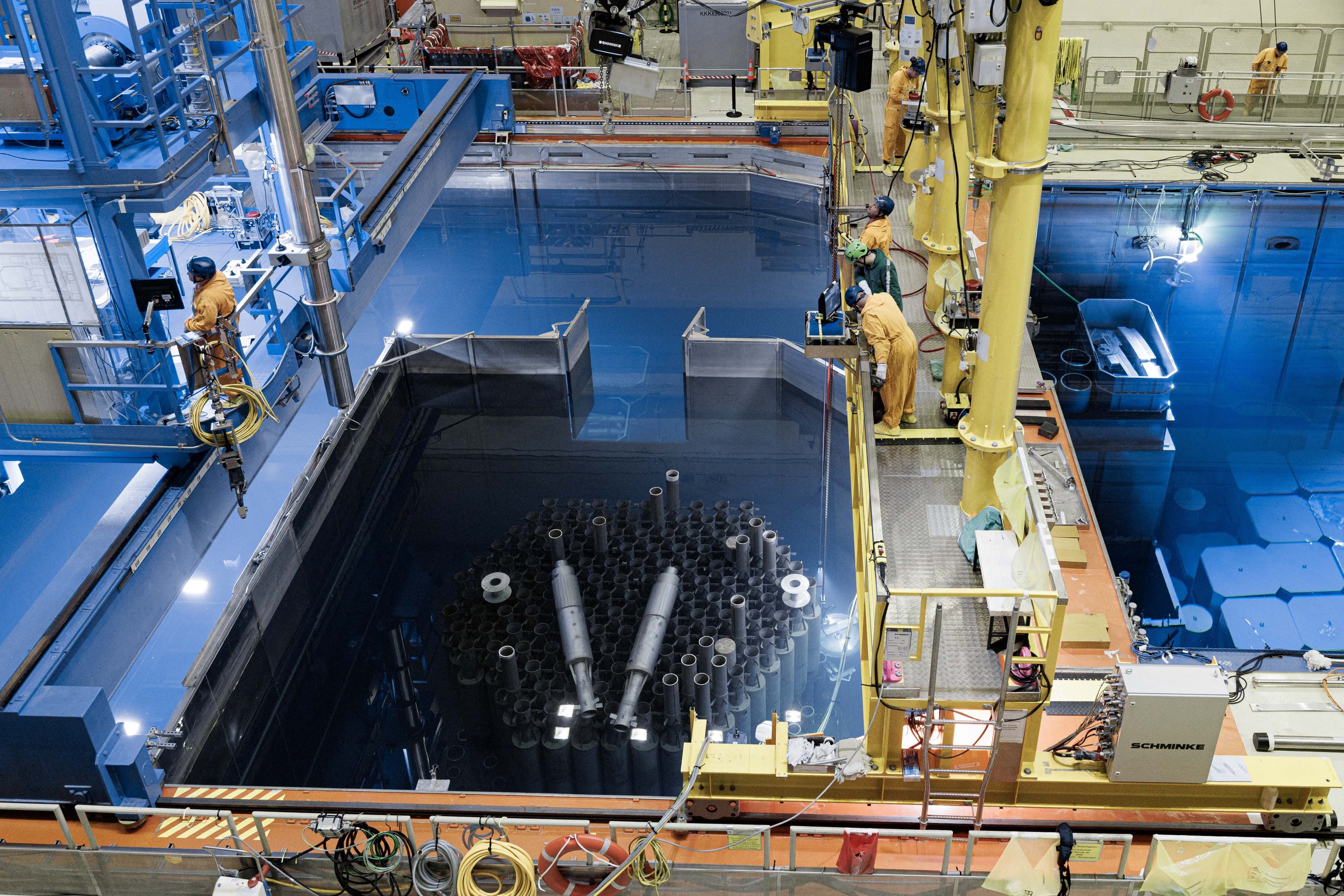
Key Insight: The logic behind ONKALO is actually quite poetic. It mimics nature. After 100,000 years, the radioactivity of that fuel will drop back down to the levels of the natural uranium ore it was dug from in the first place. It’s just returning to the earth.
Technical Nuances: Corrosion, Chemistry, and Cost
Copper is great because it doesn't rust easily in oxygen-free environments. Still, scientists keep poking at the theory. A study from early 2026 suggested we need to watch out for "hydrogen-charged" copper, which could get brittle over thousands of years.
Then there are the bacteria. Some microbes produce sulfide, which eats copper. But the engineers have a fix: they pack the bentonite clay so tightly that the bacteria literally don't have room to move or eat. They just stay dormant.
The "Polluter Pays" Financing Model
Who’s paying for this? Not the Finnish taxpayer. Finland uses a "polluter pays" programme. The power companies, TVO and Fortum, have been adding a tiny fee to every kilowatt-hour of nuclear power sold for the last forty years. That money goes into a state fund. It’s already there, waiting to be used. The bill is paid before the first canister even goes down the hole.
Comparison of Global Disposal Strategies (October 2026)
| Country | Project Name | Status (as of Oct 2026) | Host Rock Type |
|---|---|---|---|
| Finland | ONKALO | Operating License Issued | Crystalline (Granite) |
| Sweden | Forsmark | Construction Phase | Crystalline (Granite) |
| France | Cigéo | Site Characterization | Clay |
| Switzerland | Nördlich Lägern | Site Selection Confirmed | Opalinus Clay |
| USA | Yucca Mountain | Politically Stalled | Volcanic Tuff |
| Canada | Revell Site | Finalizing Selection | Crystalline (Granite) |
Stewardship Beyond Civilizations: Nuclear Semiotics
Here’s a thought: how do you warn someone in 100,000 years to stay away? Modern languages won't exist then. We’re talking about "Nuclear Semiotics"—the art of communicating across deep time.
Some experts suggested building "monuments of spikes" to look scary. Others thought about creating a "nuclear priesthood" to pass down the warning through stories. Finland’s approach is more subtle. They plan to seal the site, restore the landscape, and leave it looking like nothing happened. If there’s no "treasure" to find, maybe people won't dig.
Conclusion: The Final Commissioning
The licensing of ONKALO is the end of a 40-year marathon. But the work hasn't stopped. Now, they’ll run a "trial phase" using fake canisters to make sure the robots and sensors are perfect. The first real batch of high-level waste should hit the bedrock by late 2028.
Finland has shown that the "waste problem" isn't a technical wall we can't climb. It’s just a matter of political will and honest engineering. As the world moves toward a carbon-free future, Olkiluoto is a silent reminder: we can actually plan for the long haul.

Summary: The ONKALO Milestone
Finland has issued the first operating license for a deep geological repository, moving from temporary storage to a 100,000-year solution. Success came from a "polluter pays" model and genuine local consent. Using copper, clay, and granite, ONKALO provides the blueprint for making the nuclear renaissance environmentally sustainable for the long term.
Never Miss an Update!
Subscribe to get personalized blog recommendations and instant notifications for new articles directly on your device.