The 270 GW Structural Shift: Unpacking India’s Unprecedented Power Demand Surge and Grid Resilience
We’re seeing something new here. In the past, demand spikes were short, seasonal blips. But the 2026-27 fiscal year has stayed hot. From April through September 2026, the peak demand didn't drop below 256 GW once. It hit 270.20 GW in July and stayed at 269.06 GW in September.

This isn't just about weather. This report looks at the hard numbers from FY23 to now, the structural shifts in how India uses power, and the massive risks—from coal train bottlenecks to evening shortages—that keep grid operators up at night.
1. Five-Year Monthly Peak Power Met Trajectory (FY23 – FY27)
To get a sense of the scale, look at how the maximum peak power has climbed across the country’s regional grids (all figures in Gigawatts, GW):

The Reality Check: Peak demand jumped by 12% YoY in early 2026. If you compare May 2022 to May 2026, India added 64.82 GW of operational load in four years. That’s like plugging in the entire capacity of several smaller nations at once.
The numbers don't lie. This isn't just a "heatwave" problem anymore. It's a fundamental change in the economy. To understand the grid of 2026, you've got to look at what’s actually pulling the power.
2. What’s Driving the High Peak Baseline?
The International Energy Agency (IEA) isn't mincing words. India’s power use is growing at 6.4% every year through 2030. We’re going to need another 570 TWh of generation over the next five years.

Why the load is so heavy:
- Factories are humming (41.8% of use): Manufacturing is back. Huge power loom clusters and new factories under the PLI scheme have pushed the baseline load higher, especially in the West and South.
- The AC explosion (24.3% share): It’s hotter for longer. Air conditioning is no longer a luxury; it’s survival. This creates massive load spikes whenever the humidity or heat climbs.
- Farming goes electric (17.0% share): Solar-powered agricultural feeders are great, but they mean everyone pumps water at the same time during the day. It creates a massive, synchronized daylight peak.
- The New Tech Load: AI data centres are popping up everywhere. Add in thousands of new EV charging points, and you’ve got a permanent increase in late-afternoon and evening demand.
3. Supply Dynamics: Coal and Sun Running the Show
India has 542.4 GW of total capacity now. Grid managers have to balance old-school coal with a massive influx of solar power.

1. The Solar Cushion
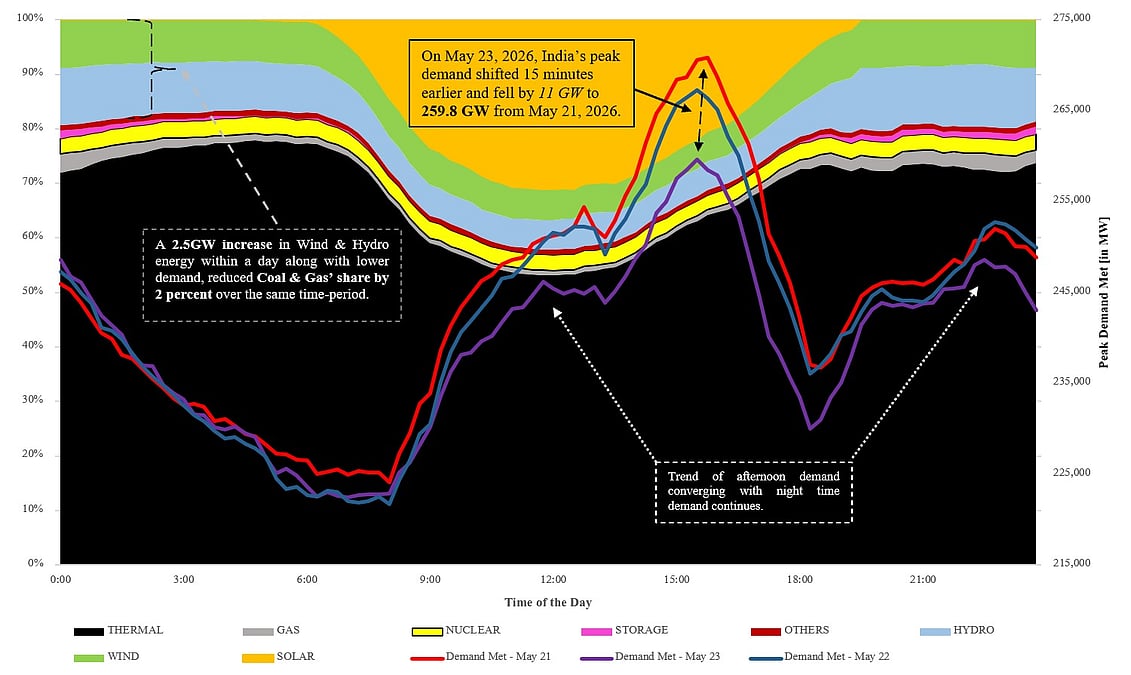
When the sun’s out (10:00 to 15:30), solar does the heavy lifting. It handles about 20% (~48 GW) of the load during the day. In the first quarter of 2026, almost every single daily peak happened while the sun was shining. This is a win—it matches the cooling and pumping demand perfectly.
2. The Evening Crisis
Here’s the catch: when the sun goes down, the ACs stay on. Between 17:30 and 22:00, solar output hits zero, but demand stays at ~250 GW.
This is where coal comes in. It still provides 67% of the actual generation when the sun isn't helping. To keep the lights on, the Ministry of Power has told coal plants to run at full tilt, using every bit of liquidity they can find on the energy exchanges.
4. Grid Stress: Where the System is Fraying
The national shortage is technically low at 0.1%, but that doesn't tell the whole story. The 2026 surge has exposed some serious cracks.

- Regional Choke Points: It’s not the same everywhere. Uttar Pradesh and Maharashtra are seeing massive localized congestion. The South has plenty of wind power, but there aren't enough "pipes" to send it North when the evening peak hits.
- The Coal Train Problem: We’ve produced over 1,000 million tonnes of coal this year. Still, 77 out of 190 plants have stocks below 25% of what they should have. Why? The railways can't move it fast enough. Throw in some monsoon rain on the tracks and high import prices, and the system starts to sweat.
- The 7 GW Gap: During those non-solar evening hours, we’ve seen deficits of up to 7 GW. Utilities have to scramble for expensive gas power just to avoid blackouts.
- Wasted Green Energy: We’re building solar and wind faster than the wires can carry it. In early 2026, we had to throw away 300 GWh of renewable energy because the transmission lines were full.
5. The Way Forward: Building a Grid That Doesn't Break
We can't just build more plants. We need a smarter way to manage the 6.4% growth we’re facing.

- Batteries and Water: India has 7.2 GW of Pumped Hydro and 3.5 GW of batteries. It’s not enough. We’ve got another 18 GW of hydro and 12 GW of batteries in the works to fill that 7 GW evening hole.
- Dynamic Pricing: It’s time to make power more expensive when it’s scarce. Time-of-Day (ToD) tariffs will force factories to move their heavy work away from the evening peak. If we can automate this for data centres and pumps, we could shave 6% off the peak.
- Fixing the Wires: We need the Green Energy Corridor Phase-II finished yesterday. If we don't fix the transmission bottlenecks, we’ll keep wasting green power while burning expensive coal.
- Real-Time Markets: Expanding the 15-minute trading markets lets operators move power across state lines instantly. It’s the only way to handle the sharp ramps when the sun sets.
Summary & Key Conclusions
- Record Breaking: India’s demand hit 270.82 GW in May 2026. The baseline hasn't dropped below 256 GW for months, driven by industry and cooling.
- Coal is King at Night: Non-fossil energy is half our capacity, but coal still does 67% of the work during the dangerous evening peak.
- Fixing the Cracks: To survive, the grid needs to fix 77-plant coal shortages, bridge the 7 GW evening gap, and stop wasting 300 GWh of green power through better storage and smarter pricing.
Never Miss an Update!
Subscribe to get personalized blog recommendations and instant notifications for new articles directly on your device.